Ageing: Why We Are Waking Up Stiffer As We Get Older, and the Most Practical Fix

The Real Mechanism
Stiffness on waking isn't damage, and it isn't really "just getting older" in the vague sense people mean it. It's a fluid and movement-frequency problem. Every hour spent still in one position lets your discs, joints, and fascia settle into a compressed or dehydrated state. Intervertebral discs in particular rely on nocturnal rehydration through osmosis while unloaded — around a quarter of a disc's fluid is expressed and re-absorbed with each daily loading cycle (1), and that process becomes less efficient with age as disc water content and hydration capacity decline (2).
On top of that, deep sleep (slow-wave sleep) — when growth hormone release peaks and tissue repair happens — declines significantly with age. Research tracking healthy men found the amount of deep slow-wave sleep dropped from around 19% of total sleep in early adulthood to roughly 3-4% by midlife, alongside a corresponding decline in growth hormone secretion (3). By around age 45, most people have lost the majority of their capacity to generate deep sleep, and growth hormone secretion during sleep falls by a similar magnitude (4). Since tissue repair is concentrated in this stage, overnight recovery of muscle and connective tissue is naturally reduced as you age.
There's also a movement piece: younger people shift position far more during sleep, which redistributes joint loading and fluid through the night. Position shifts and body movements during sleep decrease progressively with age (11, 12), and older adults spend more time in a single position — particularly side-lying — with fewer overall shifts per hour than younger adults. That means the same posture, and the same load on the lumbar spine and hips, gets held for longer periods.
Add in the joints themselves: synovial fluid depends on hyaluronic acid for its lubricating viscosity, and both the concentration and molecular size of hyaluronic acid in joint fluid decline with age — one study found hyaluronan concentration dropping by roughly 10% per decade, more strongly linked to age than to visible joint degeneration (5, 6). Fascia undergoes its own aging process too: collagen cross-linking increases, elastin content drops, and tissue hydration declines, all of which reduce fascial pliability and increase stiffness and adhesion formation (9, 10). Layered on top of all this is "inflammaging" — the low-grade, chronic inflammatory state that becomes more pervasive with age, contributing to stiffness and tissue degeneration even without any specific injury (7, 8).
Why Stillness Is the Real Culprit
None of this is really about sleep quality in isolation — it's about how much time tissue spends static without fluid exchange. That reframes the problem: instead of "sleep is the cause and there's not much to do about it," the actual lever is controllable. You can reduce how much stiffness builds up overnight, and you can clear it much faster once you're awake, by deliberately bracketing sleep with movement.
Before Bed: Reducing How Much Stiffness Accumulates
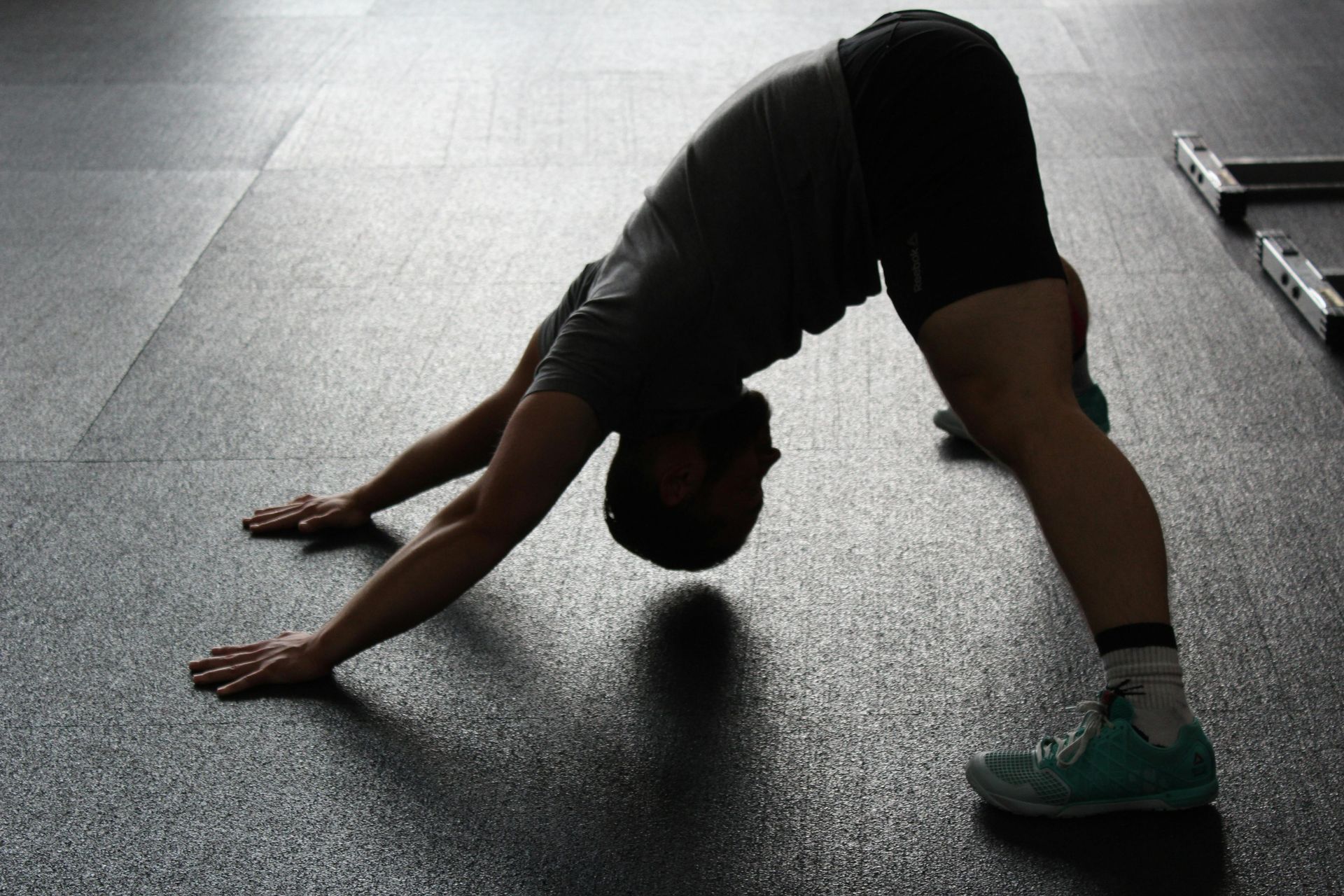
Spending 5-10 minutes on slow mobility work before sleep — targeting the areas that hold tension longest overnight, typically the hips, lumbar spine, and thoracic spine — primes fluid distribution and synovial lubrication before hours of stillness set in, rather than trying to undo the damage after the fact. Movements like cat-cow, hip flexor stretches, and gentle spinal rotations are enough; this isn't about building flexibility, it's about starting from a better baseline. As a secondary benefit, this kind of slow mobility work activates the parasympathetic nervous system, which can also improve how easily you fall asleep in the first place.
On Waking: Clearing Stiffness Fast Instead of Waiting It Out
Most people's instinct is to just get up and move through the day, letting stiffness fade naturally — but that process can take 30-60+ minutes or longer as you age. A short, structured sequence immediately on waking can clear it in a fraction of that time. The logic is to start with gentle, low-effort movement (light stretching or distal movement like ankle pumps), progress into the areas that were under the most sustained load overnight (usually the lower back and hips), and finish with a compound movement that reintroduces full-body loading — something like a slow sit-to-stand or a few controlled squats.
The order matters here. Mobilizing the spine and hips before standing and loading them prevents the "guarded," stiff-walking pattern many people default to when they get up too stiff too fast — which can itself create secondary tension as the body compensates.
The Bottom Line
Age-related morning stiffness is driven by reduced disc and joint hydration, less deep sleep, reduced overnight movement, and slower fascial recovery — all of which compound over time. But the single most practical, controllable lever isn't just "sleep better," it's minimizing prolonged stillness and treating both bedtime and waking as deliberate windows to manage fluid exchange and joint lubrication through movement.
References
- Sivan SS, Neidlinger-Wilke C, Würtz K, Maroudas A, Urban JPG. Diurnal fluid expression and activity of intervertebral disc cells. Biorheology, 2006;43(3-4):283-291. https://pubmed.ncbi.nlm.nih.gov/16912401/
- Iatridis JC, et al. Effect of Hydration on Healthy Intervertebral Disk Mechanical Stiffness. PubMed, 2015. https://pubmed.ncbi.nlm.nih.gov/26300418/
- Van Cauter E, Leproult R, Plat L. Age-Related Changes in Slow Wave Sleep and REM Sleep and Relationship With Growth Hormone and Cortisol Levels in Healthy Men. JAMA, 2000;284(7):861-868. https://pubmed.ncbi.nlm.nih.gov/10938176/
- UChicago Medicine. Aging alters sleep and hormone levels sooner than expected. 2000. https://www.uchicagomedicine.org/forefront/news/2000/august/aging-alters-sleep-and-hormone-levels-sooner-than-expected
- Temple J, et al. Hyaluronan concentration and size distribution in human knee synovial fluid: variations with age and cartilage degeneration. Arthritis Research & Therapy, 2016. https://arthritis-research.biomedcentral.com/articles/10.1186/s13075-016-0922-4
- An update on the study of synovial fluid in the geriatric patient. ScienceDirect, 2024. https://www.sciencedirect.com/science/article/abs/pii/S1699258X23002899
- Franceschi C, Campisi J. Chronic inflammation and the hallmarks of aging. ScienceDirect (review), 2023. https://www.sciencedirect.com/science/article/pii/S2212877823000893
- Source of Chronic Inflammation in Aging. PMC, 2018. https://pmc.ncbi.nlm.nih.gov/articles/PMC5850851/
- Wilke J, et al. Structural and Functional Changes in the Coupling of Fascial Tissue, Skeletal Muscle, and Nerves During Aging. Frontiers, 2020. https://www.ncbi.nlm.nih.gov/pmc/articles/PMC7327116/
- Pavan PG, et al. (as cited in fascia/aging review) — fascial densification and fibrosis with age. https://d-nb.info/1232323802/34
- Bruyneel M, et al. Sleep positions and nocturnal body movements based on free-living accelerometer recordings: association with demographics, lifestyle, and insomnia symptoms. Nature and Science of Sleep, 2017. https://pubmed.ncbi.nlm.nih.gov/29138608/
- Gyllensten IC, et al. Body movements during night sleep and their relationship with sleep stages are further modified in very old subjects. ScienceDirect, 2007. https://www.sciencedirect.com/science/article/abs/pii/S0361923007002304
Blogs